

AI is Still Booming, Popular Bets Are Busting
Here are 4 smart ways to invest.


Editor’s note: Thank you for reading Dividends Roundtable! If you like what you’ve been reading here, please consider a trial subscription. This issue includes the updated Dividends Premium portfolio, which has reached a new high-water mark with a year-to-date return of nearly 17%. To your wealth!—RC
The numbers are both compelling and real: After a blockbuster Q1, artificial intelligence-related digital advertising sales are on track to reach $56 billion in 2026. That’s up from $35 billion last year and just $1 billion in 2022.
That’s from consulting firm Madison and Wall, as reported in today’s New York Times. And unlike many forecasts issued from 30,000 feet, this one is strongly backed by the evidence on the ground. That includes Q1 revenue growth of 21.8% at Alphabet Inc (NSDQ: GOOG), the parent of the West’s leading search engine Google.
It’s clearly salad days at Google, with its Gemini AI accelerating long-held sector dominance. And times are good for the “hardware” side as well, as Wall Street waits for leader NVIDIA (NSDQ: NVDA) to report next earnings May 20.
Then there are the data centers running AI.
It’s likely much of the currently planned 780 gigawatts of data center capacity in the US won’t get built. UK-based industry research firm Aurora Energy, for example, estimates 277 GW after removing what it considered more speculative “phantom” projects. And it’s further whittled that number down by removing first-time builders and what it calls “aggressive scalers,” companies with announced plans 10 to 500 times bigger than current operational capacity.
The results is a much more conservative but still massive 81 GW from operators considered “proven” with a “reasonable pipeline” for development. And that number too is more than amply backed on the ground, with Exhibit A the Q1 results and guidance of US electric utilities reporting results so far.
Dominion Energy (NYSE: D) is the utility serving the Northern Virginia epicenter of the boom. And the company actually increased its backlog of potential new data center demand to 51 GW in updated guidance last week, from 48.5 GW three months ago.
Dominion once again provided considerable color on those orders. The majority (29.5 GW) now has a “Substation Engineering Letter of Authorization,” with the company getting paid by the data center owner to develop a “detailed engineering plan.” Another 11.1 GW now has a “Construction Letter of Authorization,” under which construction is under way with the data center owner on the hook for everything the utility spends.
The remaining 10.4 GW has an “Electric Service Agreement,” clearly defining how the customer will take service and laying out a “structure” to recover costs. These deals also have a “revenue requirement” the data center owner must pay, whether it takes service or not.
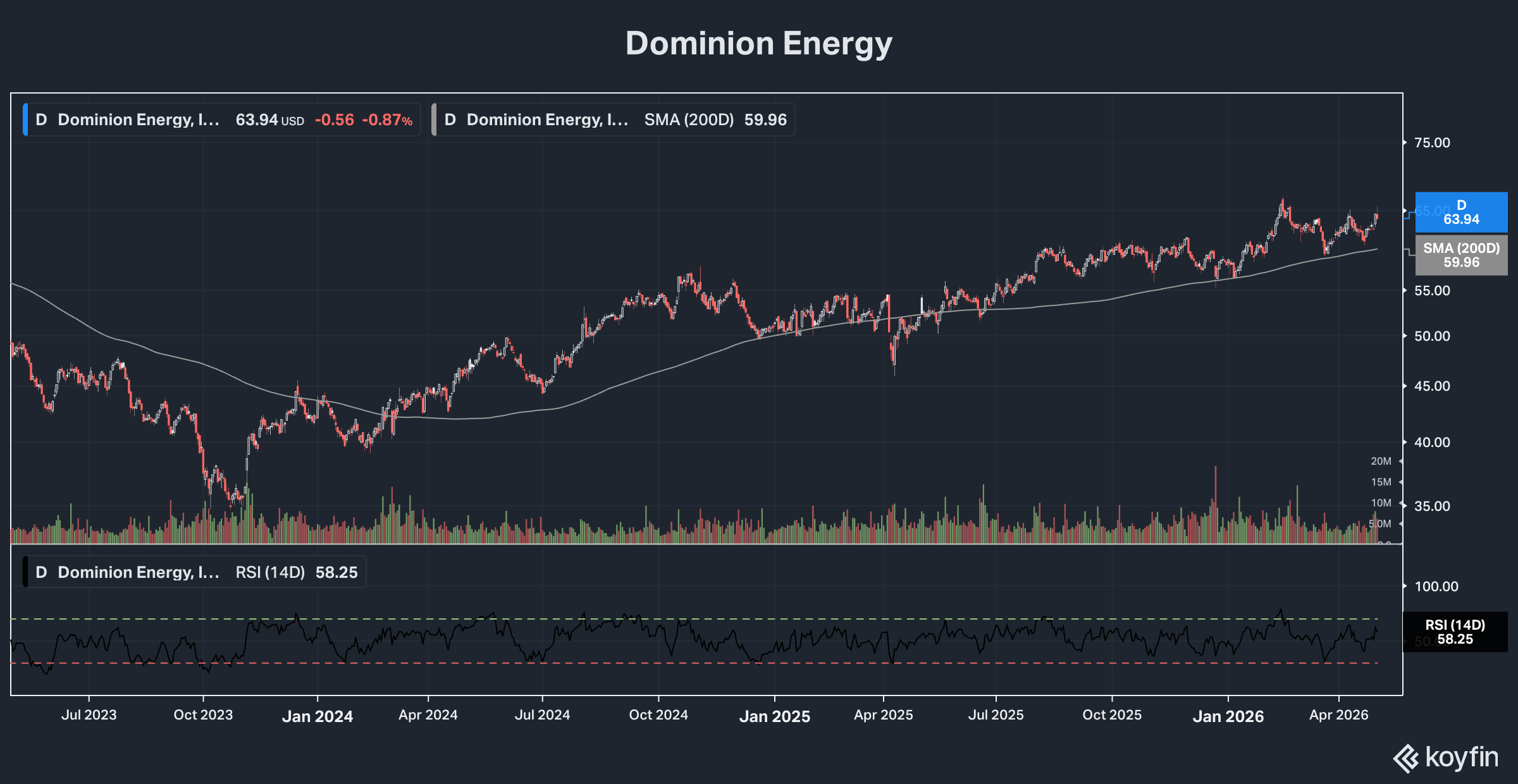
These arrangements have obviously not discouraged data center development in northern Virginia. And they offer strong protection for customers and shareholders. So does a provision that large load customers (25 megawatts and greater) will be subject to “minimum demand charges” under 4-year contracts.
Also, 76% of the new load is coming from customers that have had a relationship with Dominion for at least 10 years. Only 11% is with data center owners that have been customers for 5 years or less. And 82% have investment grade credit ratings, with Alphabet, Amazon, Microsoft and Meta all major customers.
Bottom line: Nothing is certain. But Dominion’s data center demand numbers look pretty solid. And there’s every indication they’re going to grow even more.
That’s also the message from NextEra Energy’s (NYSE: NEE) results. The leading US producer of electricity from wind, solar, battery storage and natural gas increased its data center “hub pipeline” of projects to 30 GW in its April guidance update, up from 20 GW at the end of 2024. And it’s what we’re seeing from smaller utilities as well, with Alliant Resources (NYSE: LNT) now reporting a 3.4 GW backlog.
It all adds up to a multi-trillion-dollar investment opportunity for a wide swath of industries. And that’s not including the potential productivity gains, as large and small businesses figure out how to leverage AI to make the most of their time and resources.
Utility companies are already front and center in that effort. For example, in California, Edison International (NYSE: EIX) and PG&E Inc (NYSE: PCG) are working with big Tech firms to further harden their systems against ever-worsening wildfires in the state—using AI to make faster decisions based on data collected from an ever-increasing deployment of sensor technology.
The Obvious AI Bets No Longer Work
No doubt about it. Strong Q1 results and guidance have again confirmed the bullish case for the artificial intelligence. In fact, it’s quite possible the potential impact is still being widely under-estimated, as skeptics focus on the notable failures of forerunners like Chat GPT or apocalyptic forecasts rather than on where AI has already proven genuinely useful.
Successfully investing in AI, however, is another matter entirely.
The main headline from the stock market this week was that the S&P 500 and Nasdaq reached new highs after a fifth consecutive weekly gain. But despite all the good news on Big Tech earnings, three of the so-called “Magnificent 7” Big Tech stocks finished the week underwater.
The S&P 500—which has an historic 35.3% weighting in those seven stocks—is still up less than 6% year to date including its meager dividend. Apple Inc (NSDQ: AAPL) is higher by just 3% in 2026, despite blockbuster FYQ2 results.
That’s meaningful underperformance by the former leaders.
By comparison, the long-underperforming Real Estate SPDR ETF (XLRE) is sitting on a year-to-date gain of nearly 11%. That’s despite some notable headwinds facing the property sector, notably office and residential real estate.
The Utilities Select SPDR (XLU) is higher by 9.8%. The Energy SPDR ETF (XLE) is up 33%. And the iShares Select Dividend ETF (DVY) used a benchmark for equity income portfolios is ahead by 10.4%.
The average gain for our Dividends Premium Portfolio is nearly 17% despite a couple of notable losers.
That demonstrates the value of picking your own stocks, particularly in a stock market where the most popular ETFs are heavily overweighted in a handful of extremely expensive stocks. And that advantage will only widen further in coming months.
Simply, there’s no better demonstration that a particular investment theme is running out of gas than what’s happening now: That’s the leading stocks failing to meaningfully outperform even when the business news is probably the best it’s going to get.
All too many investors had to learn that lesson the hard way in the Tech Wreck of 2000-02. The companies leading the doubling of the Nasdaq 100 in 1999 went on to change the world. In fact, if anything, what they did was widely underestimated back then. But by 2000, the stocks already priced everything in and more. Business was still great. But there was nowhere for the stocks to go but down.
To paraphrase at least one great trader, a lot of people who were ultimately proven right on the market went broke first. And that’s already been the case for those shorting the Mag 7 as a bet on a final day of reckoning.
But it’s also been both painless and highly profitable this year to bet on the biggest of Big Tech to underperform—by buying a basket of high-quality stocks plugged into other investment themes. And that should be food for thought for anyone considering plunging into the Mag 7 in coming days, based on last week’s earnings.
4 AI Bets That Still Work
That’s not to say there aren’t still ways to buy into the AI boom, which shows every sign of being at least as transformative as the IT boom a quarter century ago. But to find them, you’re going to have to be willing come out of the ETFs dominated by the Mag 7. And you’re going to have to look in less obvious places.
So, what am I suggesting now? Not surprisingly, the Dividends Premium portfolio has plenty of choices. And despite this year’s gains, they’re trading at reasonable entry points.
US Big Tech has a massive energy advantage over rivals in other countries, including China. That’s a wealth of locally produced natural gas selling at a fraction of the price of equivalent fuel in Europe and Asia.
The AI “tokens” needed for complex business solutions require enormous amounts of energy—mainly electricity—to produce. And with Germany closing its nuclear plants and Middle East supplies shut in, there’s no equivalent sourcing for natural gas in Europe to provide it. Ditto in Asia, where almost all of Japan’s nuclear power plants have been closed since the Fukushima Daiichi disaster.
The rapid pace of US data center development in the US also faces many challenges. Concerned about the potential impact on the local environment and particularly customer rates, politicians in many states are coming out against locating data centers in their districts. Others are pushing new restrictions that have forced project cancellations. And the apparent collapse of the Fermi project in Texas demonstrates even deep pockets and political connections are no guarantee of success.
Even in Virginia, there’s an ongoing debate about data centers “paying their fair share,” including a proposal in the state senate to end a tax exemption. That doesn’t appear to be going anywhere, as the state House and governor are opposed. But it does mean Dominion and its customers will have to walk a fine line to execute their plans in coming years.
That said, the US does have a massive energy advantage over global competition when it comes to business fully realizing the benefits of AI. That means a huge investment opportunity in American natural gas, with the PJM (Pennsylvania, Jersey, Maryland) grid operator projecting 106 GW of new generation under its “reformed interconnection process.”
After spiking up in winter, benchmark natural gas prices have slumped well under $3 per million BTU. And with the Strait of Hormuz still double-blocked, much of the investment attention has understandably shifted to oil.
That’s given investors another opportunity to buy some of the natural gas producers. One of the best plays is a Dividends Premium recommendation.
