

Property Stocks are Rallying
Time is short to lock in your share.


Seattle, Washington skyline, where my son Nate is getting married this weekend!
Editor’s Note: Thank you for reading Dividends Roundtable REITS edition.
Don’t look now. But the property sector is running neck and neck with the S&P 500 year-to-date. And it’s not just owners of data centers and senior housing properties gaining ground!
REITs are back in the total return conversation because they’re the rare low-priced, high potential sector in this top-heavy stock market. Prologis Inc (NYSE: PLD) announced blockbuster earnings and a guidance boost last week. And over the next month, the best of the 81 companies I track in the REIT Rater should get a similar big boost from their results—which will prove they’re learning to live with—even love—”higher for longer” interest rates and inflation.
Not much beats real property when inflation is running hot. REITs’ already lofty dividends are steadily increasing. And the five top picks I highlight in this report are poised to soar above the rest. Buy while they’re still cheap!
Got a question or comment? Challenge me at one the forums I host 24-7 on the Substack and Discord applications.
To your wealth!--RC
The old saw is bull markets truly end only with a whimper, not a bang. At a true top, the leaders have long since reached prices well beyond any reasonable measure of expectations of business value. And as they have a harder time making new highs, money sloshes around in search of the next champions to ride.
FOMO—fear of missing out—is always the prevailing sentiment at the end. Investors latch onto stocks that acquire momentum, dumping them when it seems to wane. Leading and lagging sectors constantly change places, responding to whatever headline crosses the wires. And despite all the activity, big cap averages like the S&P 500 run in place.
In contrast, sharp sudden declines in stock prices have usually been followed by big recoveries. Most recently, the S&P 500 dropped by more than one-third from mid-February through mid-March 2020. But five months later, the index was pushing out to new all-time highs.
Big declines are bullish because they effectively reset the market. They’re not much fun to live through. And having too much leverage when they start can be ruinous. But investors who’ve kept their focus on value during the rise will survive the fall. And high-quality stocks are always first to rise in the inevitable recovery—a fact that’s also true if the preceding bull market ends with a whimper.
If we’re lucky, we’ll avoid both whimpers and bangs in second half 2026. But with record concentration of ownership in a handful of Big Tech names, extreme valuations wholly unmoored from business value, dependence on the single theme of artificial intelligence growth and FOMO running hot, it’s fair to say we’re now living with elevated risk of a long overdue correction of 20% or more.
High quality real estate investment trusts are both shielded from a potential selloff and uniquely positioned to lead another leg up for stocks, if that’s in the cards. And that makes them ideal for building positions now, when so many other sectors—Tech and non-Tech—are ripe for taking profits.
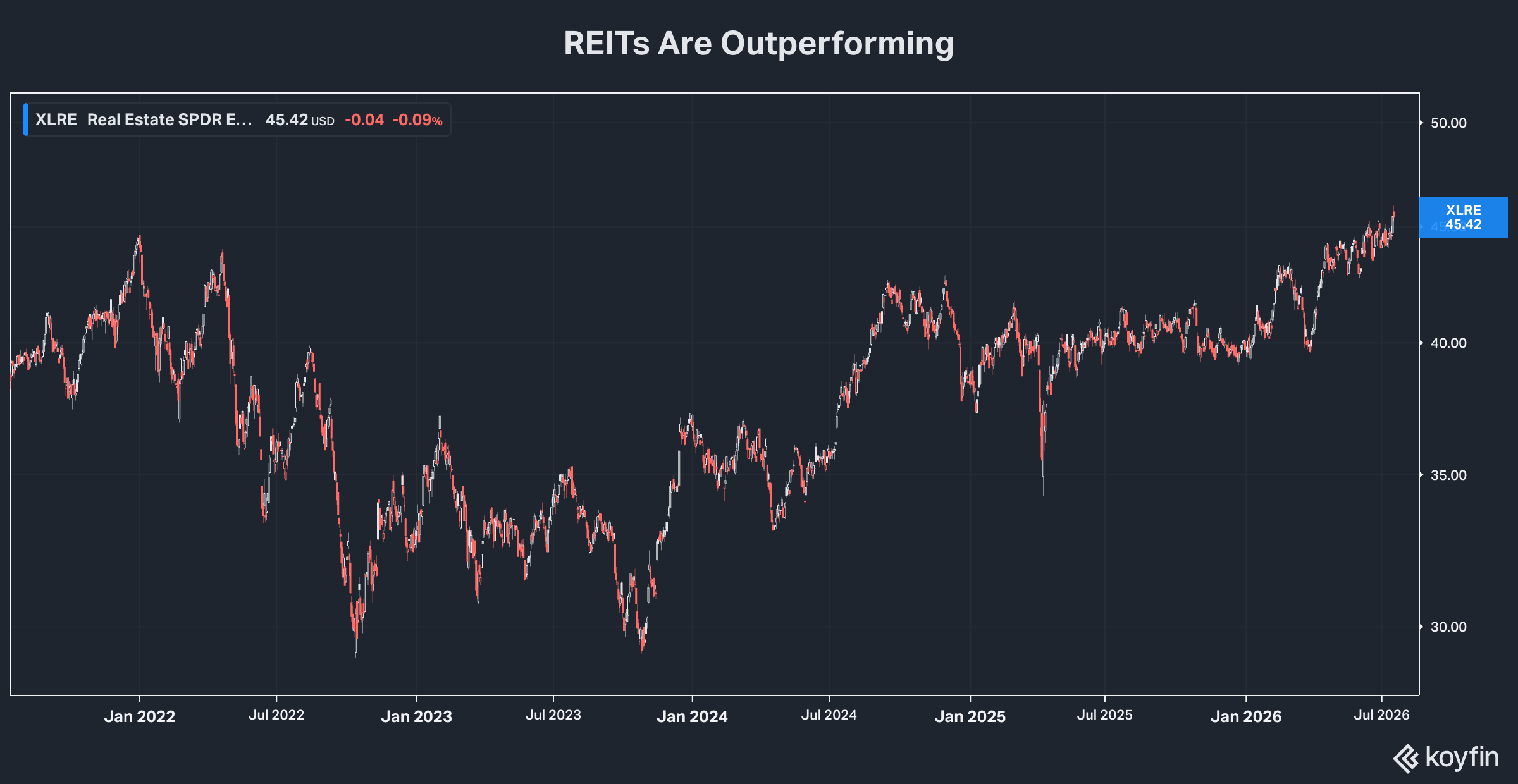
The REIT SPDR ETF (XLRE) closed Friday up 14.32% year-to-date. That strong performance is basically on the back of handful of larger companies like Welltower Inc (NYSE: WELL), which is currently 11.2% of the ETF. But the 13.6% unweighted average return of the far more diversified and higher yielding First Rate REIT list demonstrates the rally is spreading across property types.
Residential property REITs, for example, have been more or less under pressure since early 2022, when inflation peaked and the Federal Reserve began raising benchmark interest rates. And selling accelerated in mid-2025 as a flood of new supply hit markets, depressing occupancy rates and rents on new leases.
Those pressures have greatly lessened in recent quarters. Q2 figures to be an inflection point for occupancy and rents, even in the SunBelt. And sector M&A is heating up, with AvalonBay Communities (NYSE: AVB) and Equity Residential (NYSE: EQR) on track to close their merger by Q4.
Expecting Solid Earnings Ahead
I expect high quality REITs across sectors to demonstrate strength in their Q2 results and guidance updates over the next several weeks. I highlight dates to expect the news and numbers for each of the 81 companies I track in the “Commentary” column of the REIT Rater table.
As of this post, only leading industrial REIT Prologis Inc (NYSE: PLD) has reported in. And the positive business momentum highlighted in the numbers and guidance were no surprise.
What is likely to impress more are stronger-than-expected results at more than a few REITs that are currently less loved.
Part of that is simply that supply is now tightening across sectors. The overbuild of recent years in residential and self-storage, for example, has become an historic “underbuild” that will show up in future years. Oversupply is still depressing occupancy and rents. But the stage for future shortage is already set.
That’s also true for life science property after five years of a Biotech industry slump, arguably made worse by erratic federal government policy on research funding. Alexandria REIT (NYSE: ARE) shares were pushing toward $200 in 2021. Now they’re selling for less than $50. But management is strongly hinting prior to Q2 results (August 3) that the outlook is improving rapidly for its Class A/A+ “campus” properties.
Retail REITs like Kimco Realty (NYSE: KIM) have been reporting upper 90s percent occupancy and robust rent growth for several years now. That’s largely the result of tightening supply for top-quality properties, with leading owners focused far more on acquisitions than new development.
Wall Street analysts for the most part, however, still seem convinced the sector is highly vulnerable to Americans’ affordability concerns. As a result, their outlook is tepid even for leaders like Kimco. And these stocks are cheap going into what should be another round of strong results and robust demand for their properties.
Data center developers are increasingly encountering local opposition to expansion. That means tighter supply for longer. It also puts a premium on where builders are successful, which will benefit REITs like Prologis. And the market continues to tighten for senior housing (SHOP) as well, also as sector REITs focus on acquisitions rather than development.
I also expect REITs to impress on costs. Several including AvalonBay are now employing artificial intelligence to be more data-focused, enabling them to respond to market conditions faster than ever. Others are realizing new scale advantages and synergies from acquisitions. That’s likely to be a huge long-term benefit for shareholders of Public Storage (NYSE: PSA) and National Storage (NYSE: NSA) after they close their merger July 22.
Higher for longer interest rates remain a burden for REITs, because almost all have historically relied heavily on debt financing. But though interest expense is likely to rise for most in Q2, there are clear signs companies are adapting to higher rates—with prospective returns on new investment more than offsetting increased finance costs.
I highlight the past month’s bond issuance and credit line news in the “Commentary” column of the REIT Rater for each company. That includes some debt refinancings extending maturities at a higher cost.
For example, financial REIT Starwood Property Trust (NYSE: STWD) issued $500 million “sustainability bonds” at an interest rate of 5.875% (maturing in 2029). Proceeds will fund redemption of $500 million bonds maturing 2027 at an interest rate of just 4.375%.
Clearly, that means Starwood will be paying more for that $500 million of borrowing than it was before. But at the same time, management also reported raising $10.2 billion of very low-cost capital to fund “Starwood Distressed Opportunity Fund XIII,“ which will invest primarily in the US and Europe with “selective opportunities” in the Asia Pacific.
Starwood makes a pretty good case that well-run REITs are still finding ways to access funding at a low enough cost to make investments worthwhile, regardless of where Fed Funds is. So does Realty Income’s (NYSE: O) announcement of a $6 billion partnership with privately held Cloud Capital and a “global institutional investor” to fund $6 billion in hyperscale data center investment in the US, with “intention to expand” in Europe.
I expect several REITs to boost FFO guidance this summer, as their acquisitions and other investment run ahead of projections. That should deliver a lift to share prices, especially in sectors like retail that still seem to be climbing a very tall wall of worry.
To be sure, a sustained drop in borrowing costs would be bullish across the board for the REIT sector. And that’s exactly what would happen if inflation is brought under control enough for bond investors to turn bullish.
That appeared to be happening in late 2024. It seems less likely now to occur any time soon with Consumer and Producer Price inflation still elevated, despite a bigger-than-expected drop in June figures thanks to lower energy costs.
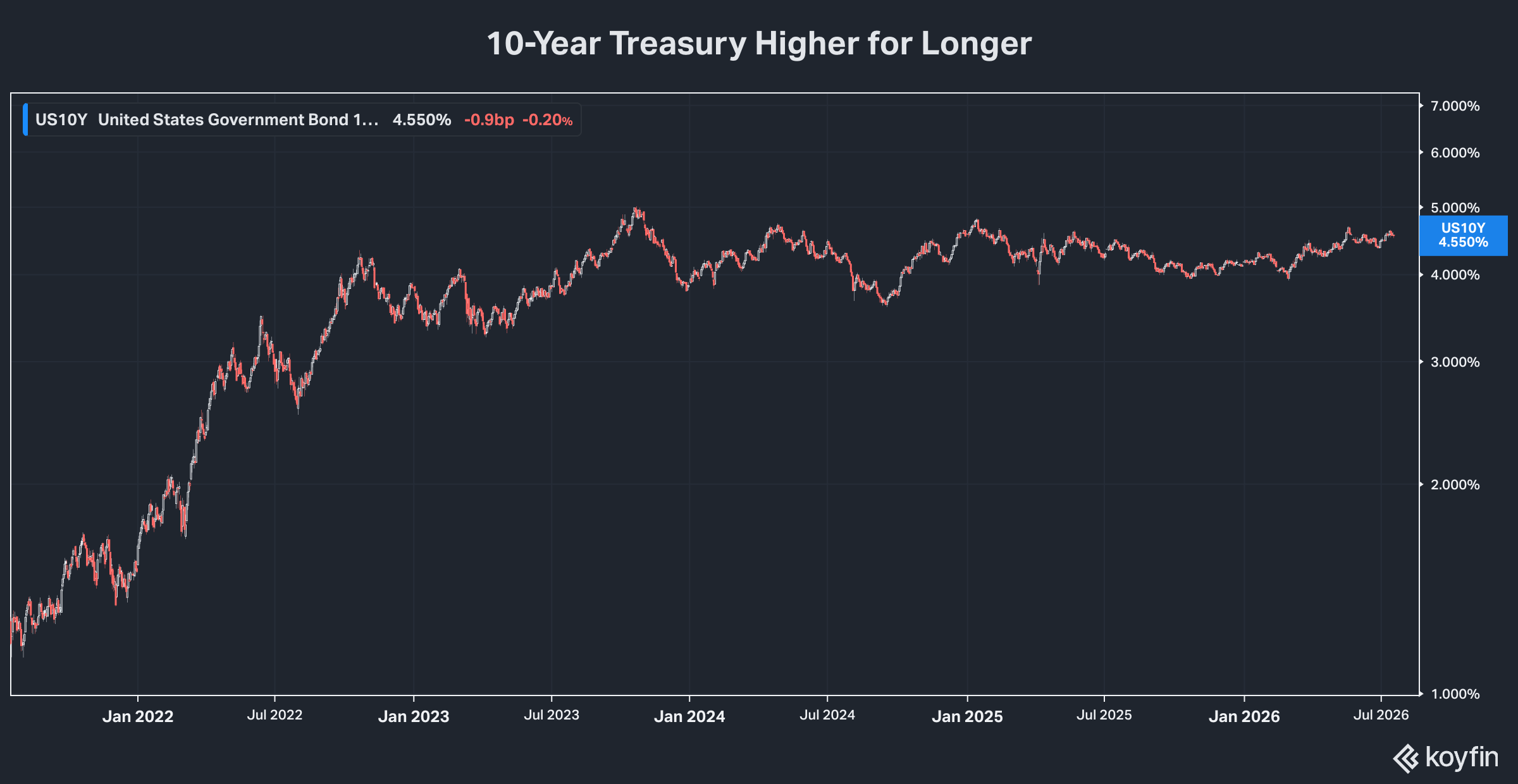
It’s notable that despite rising inflation and a once again hot war in the Middle East, gold prices are down around $4,000 an ounce, after reaching $5,500 plus earlier this year. Neither has the 10-year Treasury note yield managed to poke above 5%, as it did earlier in the decade.
That suggests that despite the headlines, the consensus is still confident inflation will prove transitory. And if that proves to be the case, REITs’ borrowing costs will plunge, and share prices will surge.
By owning best in class REITs, we’ll be positioned to profit if that happens. But the point is the main takeaway from Q2 results and guidance is likely to be that these companies are set to win even if borrowing costs remain elevated.
The sector is now adapting well to the current environment of higher inflation. And so long as that’s the case for the stocks we own, we can look forward to strong long-term capital appreciation and growing dividends.
This report’s central mission is to highlight the best-in-class REITs for building real wealth. I highlight the best entry points, as well as the prime places to exit when it makes sense to take a partial of full profit. And to do that I follow the following four rules:
· Own only REITs with underlying businesses that are growing and getting stronger. The best clue to what we’ll see in Q2 results for most is what happened in Q1. And you can read my analysis in the “Commentary” column of the REIT Rater databank. For more information on this comprehensive databank of 81 REITs, see the “Key Points and Ground Rules” discussion at the end of this report. I also now feature Quality Grades from A (safest) to F (riskiest) for a more comprehensive assessment of risk.
· Do not chase REITs above my highest recommended entry points. And take new positions in increments of three, rather than all at once—even if stocks are at Dream Buy prices. This is basic dollar cost averaging. Follow this rule and you’ll always buy more shares at the lowest price.
· Take profits in big winners when they trade above “Profit Taking” prices in the REIT Rater table. These stocks are trading at price levels that have not held historically. It’s time to take at least some of the money and run!
· Never load up on any one REIT. Always balance and diversify your portfolio. The corollary is I never double down on a falling stock to reduce cost basis.
Top 5 Fresh Money Buys and Sells
In my REIT report last month, I highlighted several reasons to expect higher returns from REITs the rest of the year. All remain compelling.
· REITs are building business momentum, meaning more earnings beats and guidance increases with Q2 results, with occupancy and rents advancing and REIT investment plans expanding.
· REITs continue to demonstrate their ability to raise debt capital on favorable terms relative to prospective investment returns. That includes accessing private capital, renewing credit agreements on favorable terms and bond issuance on reasonable terms. And if the consensus inflation is transitory holds up, the resulting lower borrowing costs should accelerate investment at many companies.
· M&A is heating up. I expect more deals as management looks for ways to boost margins by cutting costs and growing investment.
· REIT shares are still historically under-owned. Though a handful are now a decent chunk of the S&P 500, the sector as a whole is barely 1% of the Big Tech-focused S&P 500. That makes them increasingly attractive as alternative investments that are less exposed to a long overdue 20% correction in the big market averages.
· REIT share prices are low and dividend yields are high. Many REITs trade at or below book value and at a big discount to property held by private capital.
As always, some REITs are better buys than others. And not all dividends are safe.
Financial REITs, for example, are still under pressure from a combination of volatile interest rates and credit concerns. We’ve already seen several big dividend cuts in the sector, most recently KKR Real Estate Finance Trust (NYSE: KREF) despite its sponsorship by private capital firm KKR. And last month, Blackstone Mortgage Trust (NYSE: BXMT) announced a loan default equivalent to roughly 2% of its overall portfolio.
In addition, we may not have seen all the carnage we’re going to in the office sector. BXP Inc’s (NYSE: BXP) results on July 28 are going to show Class A or “premium” office is getting stronger, with occupancy and rents heading higher. But vacancy of non-premium buildings is still rising. And holding too much debt is a concern, even for owners of premium buildings.
Bottom line: We still need to be careful what we own in the property sector. But if we take our cues on what to buy and sell from Q2 results and guidance updates, we’ll dodge the worst risks and stay in the game for the big gains the sector looks headed for the next few years.
So, with all that in mind, here’s what am I advising buying in the REIT sector now, with the key news and numbers just ahead.
