

The AI Gold Rush is Breaking Utility ETFs
But there are still buys in the world's best-placed sector.


Data centers in Ashburn, VA.
Editor’s note: Thank you for reading Dividends Roundtable!
This week, I’m in the thick of Q2 earnings and guidance updates, putting every company I recommend through the wringer. And as always, the question is the health and growth of underlying businesses.
In this post, I highlight utilities and essential services. Once again, these companies are proving themselves as a low-risk way for investors to tap the AI boom. But in this ETF-dominated, conviction-less and momentum-driven market, they’re getting sold. And sector ETFs are on shaky ground.
I see buying opportunities. And I’m sharing two with you in this post.
Got a question? I’ll be launching a subscribers-only Dividends Roundtable web forum in the coming weeks. Until then, challenge me 24-7 on the Discord and Substack applications. Here’s to the Dog Days ahead!—RC
Year to date, Dividends Premium portfolio stocks are beating the S&P 500 by better than 2-to-1, with a 21.36% total return. Not every recommendation is in the green. But clearly, with five months left, 2026 is a great year to build wealth with high-quality dividend paying stocks across sectors.
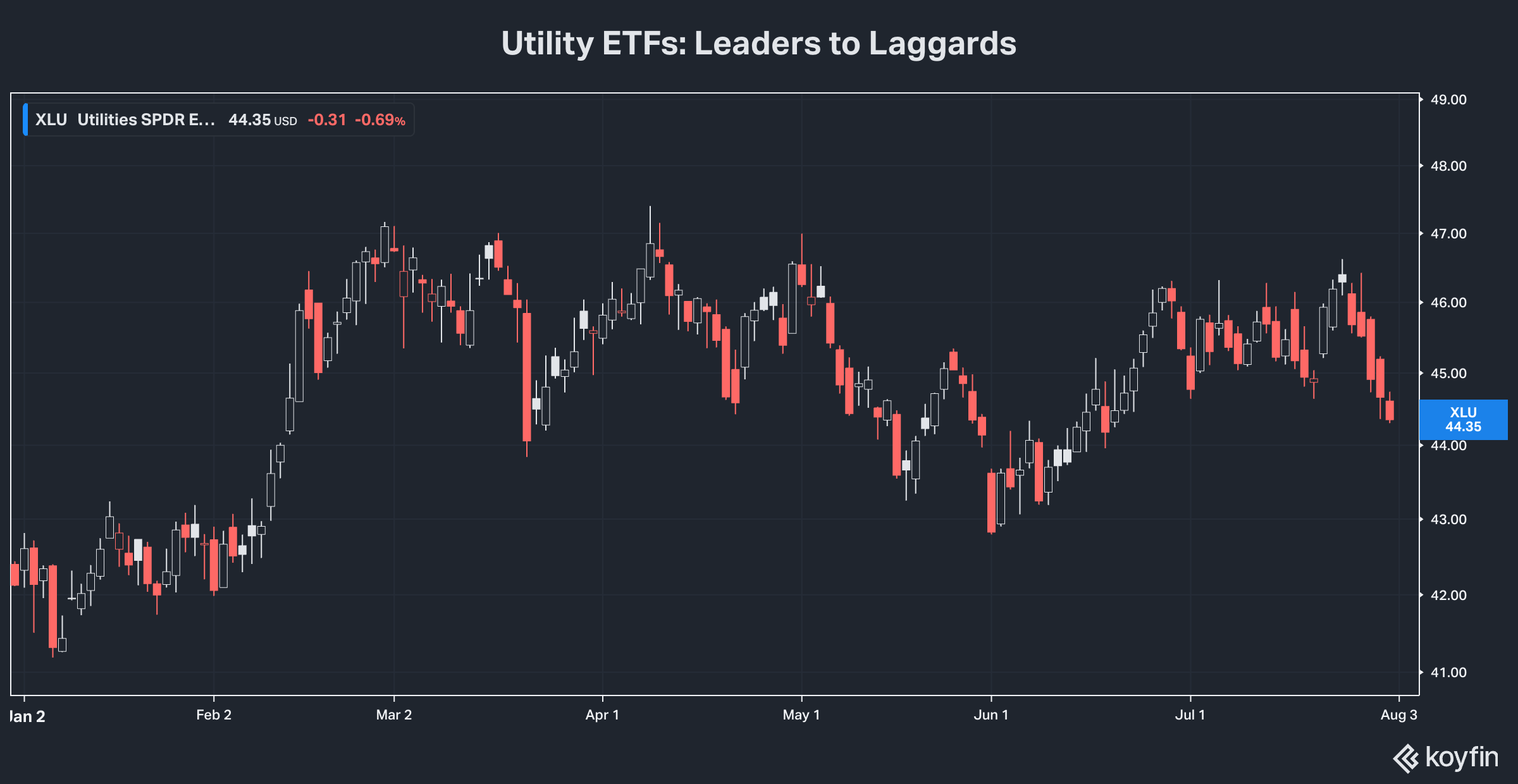
Ironically, one key high payout sector is now a 2026 laggard: Utility stocks.
The SPDR Utilities ETF (XLU) is still in the money for the year with a return of 5.3%. But nearly half of that is from dividends. And it’s still barely half the SPDR S&P 500 ETF at 10.1%, which is almost all capital gains.
That’s a fairly substantial turnaround from earlier this year, when the utility index led by a wide margin. In fact, the group has been among the market’s leaders since early 2024.
Why the reversal of fortune?
One reason is elevated sector swapping. One day, Technology appears unstoppable. The next, Apple et al are selling off as investors pour into Energy and Materials, only for the sectors to swap places again hours later.
Big investment media toss off terms like “risk on” and “risk off” in an attempt to explain the action. The reasoning is some sectors and investments are considered “safer” and more attractive when big economic factors sour, while others are better buys on bullish news.
Call it FOMO—fear of missing out—versus FOLB, fear of losing big.
OK, maybe that second acronym won’t stick. But recent action doesn’t exactly fit into those neat little boxes anyway. And that includes the weakness in many utility stocks this summer.
So what is going on? First off, it should be said that there’s still a lot more green than red in 2026 in the 160 plus utilities and essential services stocks I’ve tracked, some more than 40 years now. In fact, there are more than a few substantial winners.
Some like Edison International (NYSE: EIX) are recovering from losses sustained in 2025. But others like Entergy Corp (NYSE: ETR) have added substantially to big gains from 2024-25.
The biggest upside driver for utility stocks is underlying businesses are in the pink of health.
That’s strongly confirmed by the Q2 results and guidance updates we’ve seen so far. Earnings are growing at their fastest clip since the 1960s. And half the companies reporting in so far have actually increased their guidance for 2026.
There’s no better forecaster of a rising stock price and dividend than a healthy and growing underlying business. And utilities’ earnings power is easily the most secure of any industry—backed by regulated and long-term contracted cash flow.
Scores of dividend companies across industries cut payouts in the Great Recession of 2027-09. And scores more did so in the pandemic year of 2020, though damage to the stock market was considerably less and shorter-lived.
But not one regulated utility company did in either bear market. Sector stocks were volatile. But patient investors kept getting paid. And here are two other underappreciated facts:
· Not one regulated US utility has ever gone out of business. And every single one that’s stumbled in 125 years has ultimately recovered.
· Every single one of the literally thousands of utility mergers over the last 125 years has created a financially and operationally stronger company.
No other industry or sector can make either claim. And now electric, natural gas, communications and even water utilities are ramping up to take advantage of their most powerful growth opportunity since the Great American Suburbanization of the 1950s and 60s—providing energy to run artificial intelligence data centers.
The “picks and shovels” case for utilities being AI growth beneficiaries is now actually pretty mainstream. That is, the shop keepers selling picks and shovels to miners were huge and certain beneficiaries of California’s Gold Rush in the 1840s. So, utilities selling electricity, natural gas, water and access to advanced communications are the essential winners from proliferation of AI.
Anyone who’s read my Conrad’s Utility Investor service saw that argument repeated—probably ad nauseum—well before it became “cool.” And if you jumped on it even as late as early 2025, you’ve seen your utility stocks benefit richly. In fact, the gains in the CUI portfolio the past two and half years are the best I’ve seen in this sector. And that includes the 1980s, 90s and 00s.
What’s Behind the Selling?
It’s not because of rising interest rates.
Yes, the 10-year Treasury note yield is getting scarily close to 5%, pulling up utilities’ borrowing costs with it. The Federal Reserve’s decision not to raise the Fed Funds rate last week may not be a tacit admission that a weaker economy in an election year is tying its hands. But with inflation well over the target 2% rate—and supply chain disruption a threat to push it higher—bonds’ selloff on the news is a pretty clear sign some people think that’s the case.
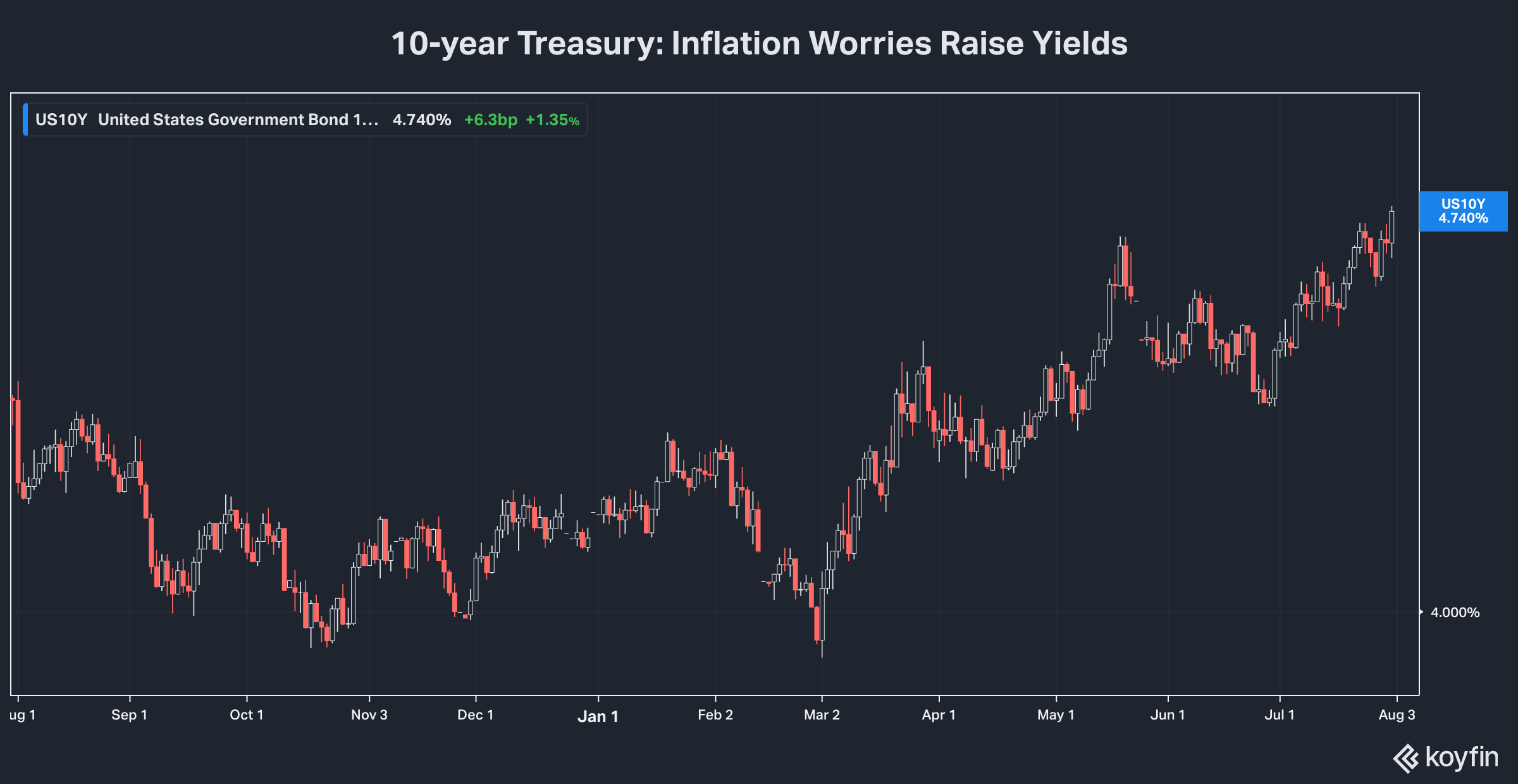
But while borrowing costs could go higher the rest of this year, there is no lock-step correlation between utility stock returns and benchmark interest rates. In fact, utilities have performed best in years of rising rates, because they’ve indicated a healthy economy. And the worst years have been years of falling interest rates, like 2008 when the 10-year T-note yield dropped by roughly 50%.
Like all stocks, utilities perform best when the economy is healthy and earnings are growing. And while Southern Company (NYSE: SO) and others are arguably restraining dividend growth at a time of higher for longer interest rates, they’re also finding ways to finance elevated capital spending at manageable cost—the proof being Southern actually increased guidance when announcing Q2 results last week.
It’s not because of regulation.
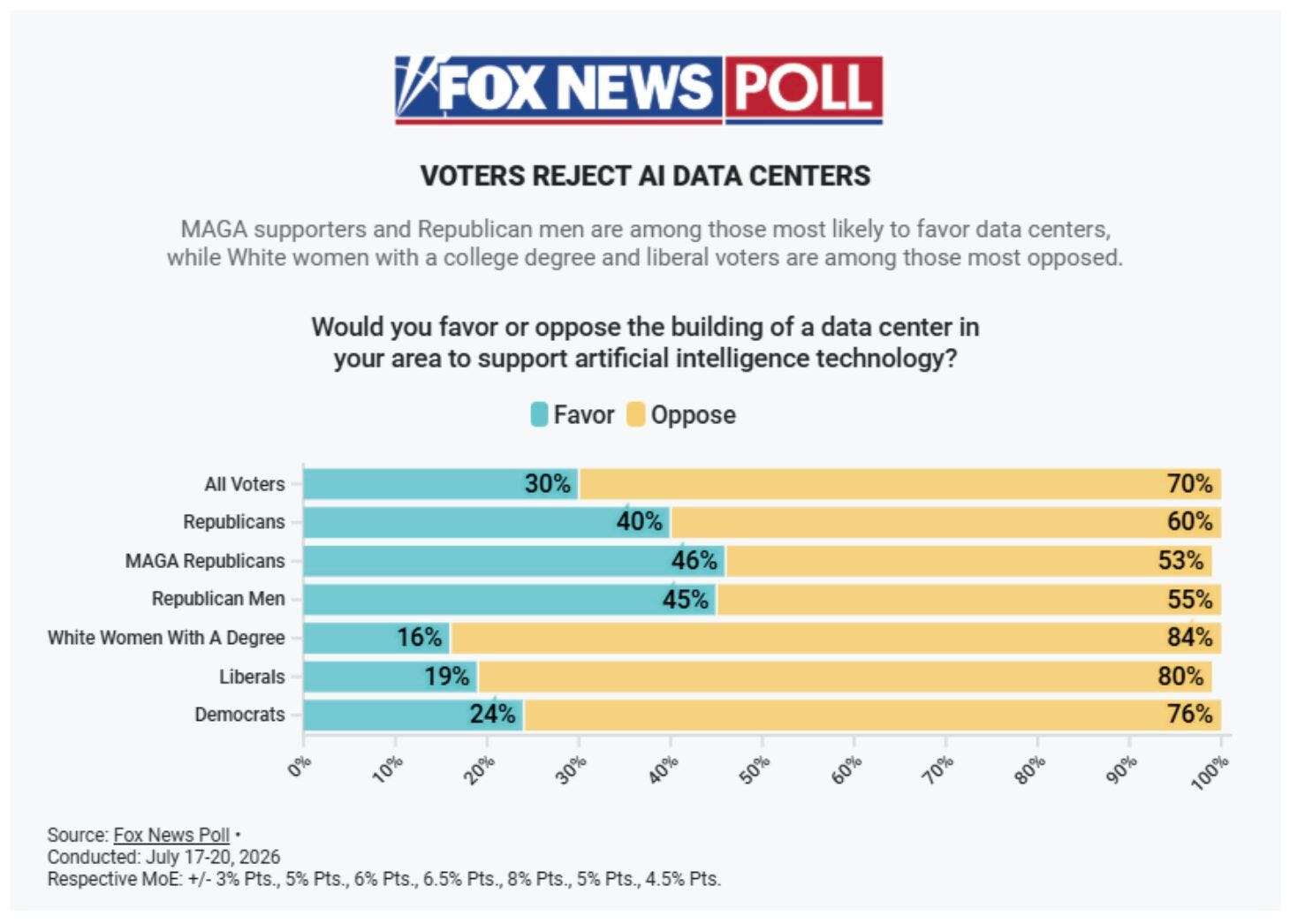
Yes, there’s a growing backlash in many places to construction of new data centers. New York Governor Kathy Hochul acknowledged the political pressure in her state by “pausing” environmental permits for up to one year, for the stated reason of evaluating the impact on the grid. And a recent report by the firm Data Watch Center cited $64 billion of blocked projects through the end of Q1 alone.
Utility Dive reports the PJM Interconnection Board plans to ask the Federal Energy Regulatory Commission for approval to essentially cut power to existing data centers “when grid demand levels near emergency conditions.” That’s in response to a new estimate that “large loads” could grow by 70 gigawatts in the PJM region by 2038.
An estimated 82 GW of “behind the meter” data center projects have been proposed over the past year—with AI companies attempting to bypass the grid altogether. “Affordability” concerns about rising electricity rates have increased politicians’ appetite for cutting utilities’ return on equity in states like Maryland. And regulators are putting spending under the microscope even in historically pro-business states like Texas, where Entergy Corp (NYSE: ETR) is defending its $1.8 billion purchase of the 1.26 GW Cottonwood power plant.
But for all that, utilities are still locking in new data center business and thereby fueling the sector’s strongest earnings growth in decades.
That’s the clear verdict from the utility Q2 earnings and guidance updates we’ve seen so far.
Dominion Energy (NYSE: D), far and away America’s leading power provider for data centers and AI, raised its total pipeline of future demand to 53 GW, up from 51 GW at the end of Q1 and 48.5 GW at the beginning of the year—with 12 GW of that now under full ESAs (electric service agreements).
Dominion’s would-be merger partner NextEra Energy (NYSE: NEE) raised 2026 earnings guidance. That followed a robust increase in new “large load” demand at its FPL utility to 21 GW with 12 GW in “advanced discussions.” And its unregulated Energy Resources unit captured another 3.6 GW of new orders—the second largest quarterly intake in its history following Q1’s record tally. And its transmission line backlog reached 3,200 miles either in operation or under development.
FirstEnergy (NYSE: FE) boosted its data center backlog by 2.1 GW to 25 GW. That’s in addition to 6.4 GW of already contracted demand, led by a 137% sequential increase in West Virginia to 4.3 GW. And it triggered an increase in the company’s projected annual earnings growth rate to the “top end” of the previous 6-8% target rate.
Why Utility Stocks ARE Being Sold
This is undeniably good news. But equally, it’s clear investors have shrugged off any positive implications.
Southern Company, for example, dropped roughly -3% the day it announced Q2 results last week. NextEra is off about -3.5% since July 24, when it produced its strong numbers.
American Electric Power (NYSE: AEP) had the biggest Q1 to Q2 boost in large load demand, boosting its pipeline to 69 GW, up from 63 GW three months ago. And the utility raised 2026 guidance on the strength of 4.6% higher retail sales, fueled by a 14.9% jump in commercial volumes. Nonetheless, its shares have dropped -4.5% in the two days since last week’s earnings release.
I see four reasons for last week’s utility stock selling, which built on weakness from late spring and early summer:
· High valuations = harder to beat expectations.
· Buy on rumor, sell on news.
· Big Tech FOMO.
· Broader economic and political concerns.
Many utility stocks are still selling at reasonable prices relative to business health and growth. But a number of high-profile companies—including American Electric Power—arguably became unmoored from those valuations as momentum stocks and proxies for AI growth.
These are also the stocks most heavily represented in utility sector ETFs. So, when they get sold off, they tend to take the whole ETF down with them at least temporarily.
AEP, for example, traded for much of the summer above my “consider taking profits” price of 130. It’s no longer that high. But it’s another good example of how it sometimes makes sense to take at least a partial profit in a big winner that’s trading in uncharted territory.
Stocks often rally ahead of earnings announcements and then drop after the news is out. I don’t think that’s been so much the case with utility stocks this summer. But it is true the best in class especially have been moving higher since the beginning of 2024. And dividend yields on several companies have dropped under 3%.
That indicates to me a very high bar of expectations. And arguably, that’s been magnified by what’s become a rising estimates game on the part of Wall Street analysts, where 12-month price targets are continually raised for stocks in an uptrend—and cut behind companies with falling share prices.
The largest technology stocks have arguably become the ultimate FOMO and FOLB investments: Investors are simultaneously terrified of missing out by holding too little of them, as well as of getting stuck with them in a repeat of the 2000-02 Great Tech Wreck.
In my view, anyone who owns any generic “stock” fund or investment based on big cap indexes probably already owns enough Big Tech. The three largest—Apple Inc, NVIDIA and Microsoft—are together more than 20 cents of every dollar invested in the S&P 500. The top seven are 34 cents of every dollar.
That’s pretty historic overweighting. And in past cycles, that level of market concentration has never ended well for those most exposed to it.
But that hasn’t stopped investors from pouring into sector ETFs to capture upside momentum. And as my friend and colleague Elliott Gue has written in his Substack “Free Market Speculator,” there’s a case for these stocks heading even higher before any eventual reckoning.
I think we can do better seeking value in other sectors including utilities. And in fact, the Dividends Premium portfolio positions have roughly kept pace with the SPDR Tech Sector ETF’s (XLK) 22% year-to-date return, with much higher income and less risk.
Utility stocks, however, are now as a sector well behind Big Tech for 2026, after leading it most of the year. They’re indispensable as ever to the AI revolution. And Q2 results and guidance demonstrate they’re still building growth, with far less risk than Big Tech stocks.
But this is a stock market where investors chase momentum and often ignore share prices’ relationship to business value. That means money is going to continue to slosh around. And utilities and Big Tech—however conjoined they are now in real economic terms—are likely to keep trading places in the stock market.
The 10-year Treasury note yield did close last week at 4.74%. That’s a clear sign inflation worries are rising, even though gold prices have been unable to break out from their recent range around $4,000 an ounce.
Higher inflation means continuing upward pressure on utilities’ costs, including for issuing new debt to finance CAPEX. It also means affordability remains front and center for upcoming November elections.
If political polls are any indication, Republicans are headed for an historic defeat on both the federal and state level. There are also nine states where voters will elect new utility regulators: Arizona, Georgia, Louisiana, Montana, Nebraska, North Dakota, Oklahoma and South Dakota.
Data centers are increasingly blamed by the public for rising electricity bills. A recent Politico poll found 41% of Americans would oppose a data center built within three miles of where they live, versus just 24% who would support one. Those same numbers were 28% opposing and 37% supporting in January.
That suggests a more restrictive environment for data centers nationally next year if forecasts of a Blue Wave pan out. And combined with affordability concerns pressuring regulated returns, it likely means some utilities (and their shareholders) will see forced reductions in CAPEX and therefore earnings growth.
These Concerns are Overblown
There’s no doubt in my mind that approaching elections are an increasing investor concern for utility stocks. It’s almost certainly why many have more or less yawned at the continuing robust order flow from data center customers highlighted so far in utilities’ Q2 results and increased guidance. And the worry is likely to weigh on the sector as we get closer to November.
I’m not in the business of making political forecasts. What I am willing to bet on is these concerns will prove well overblown at many companies, just they’ll be on the mark at others. And if we keep a sharp eye on actual business developments, we’re going to be able to spot a great deal of utility sector value in the next six to nine months.
For one thing, not every state is at risk of political upheaval this year. And even in those that are, utilities are already insulating themselves from fallout by locking in long-term rate deals and with data center contracts substantially reducing risk to other ratepayers.
It’s also worth pointing out that utility CAPEX is primarily on projects that can be completed in 12 to 18 months with locked in costs pre-approved by regulators. There are no big projects where utilities haven’t been recovering costs all along, as was the case with the nuclear and coal buildout of the 1970s and 80s. That means the worst that can happen is a state will restrict new investment, restraining future growth.
The right investment approach as always is to follow four basic strategy rules when managing your dividend stocks, including utilities:
· Build positions in companies with underlying businesses that are positioned for long-term growth and have healthy balance sheets. Sell when the business numbers warn you otherwise. Regulation is especially important assessing utilities. But be sure to listen to actual developments, rather than conjecture from a politics-based source.
· Maintain a cash reserve against the possibility of a broad correction. My favorite parking place for cash is still the Vanguard Federal Money Market (VMFXX.
· Never overload on any one stock. That’s no matter how attractive a particular company looks. And spread your bets to limit risk of a single position taking you down.
· Make fresh investments in increments of two to three, rather than all in one purchase. That’s how you’ll always buy more at the lowest price.
I write this in the middle of earnings reporting season, with a lot to digest. I will have a considerably more informed view of this sector the following week, when Conrad’s Utility Investor posts and I update my Dividends Roundtable databank.
But here are a pair of utility stocks I like now—for a combination of yield, growth and safety with their earnings power locked in the next few years despite economic and political uncertainty:
